
BLOGS > FEBRUARY 14, 2025
BY ASHLEY HEALEY AND STEVE GAGNON
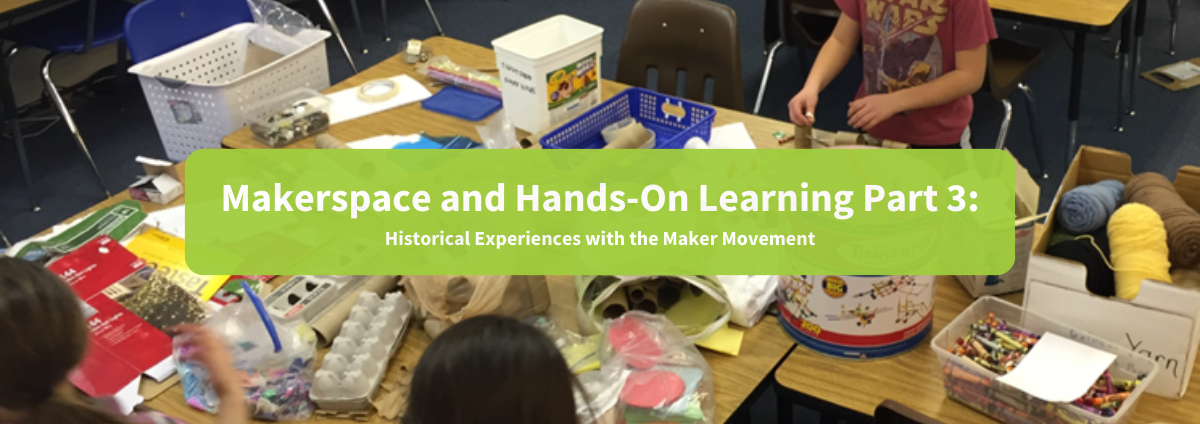
Steve Gagnon, DLS, and Ashley Healey, LMS, are the dynamic duo of Stratham Memorial School’s newly rolled out Learning Commons Program. With a combined 45 years in education, they’ve seen the evolution of Makerspace culture and have dabbled with a wide variety of materials and structures both within the classroom setting; within a block of a unified arts schedule; and within a blended, collaborative, learning format as they’re now experiencing. They’re excited to share their journey with you.
Read Part 1 Read Part 2 Read Part 4
STEVE: At the beginning of the first year, we knew we had to meet with staff members, especially classroom teachers, to communicate the change in programming. As shared in our last post, Ashley, Danie, and I explained the shift in the meetings and presented the Venn diagram image (see below) that we created as a visual aid.
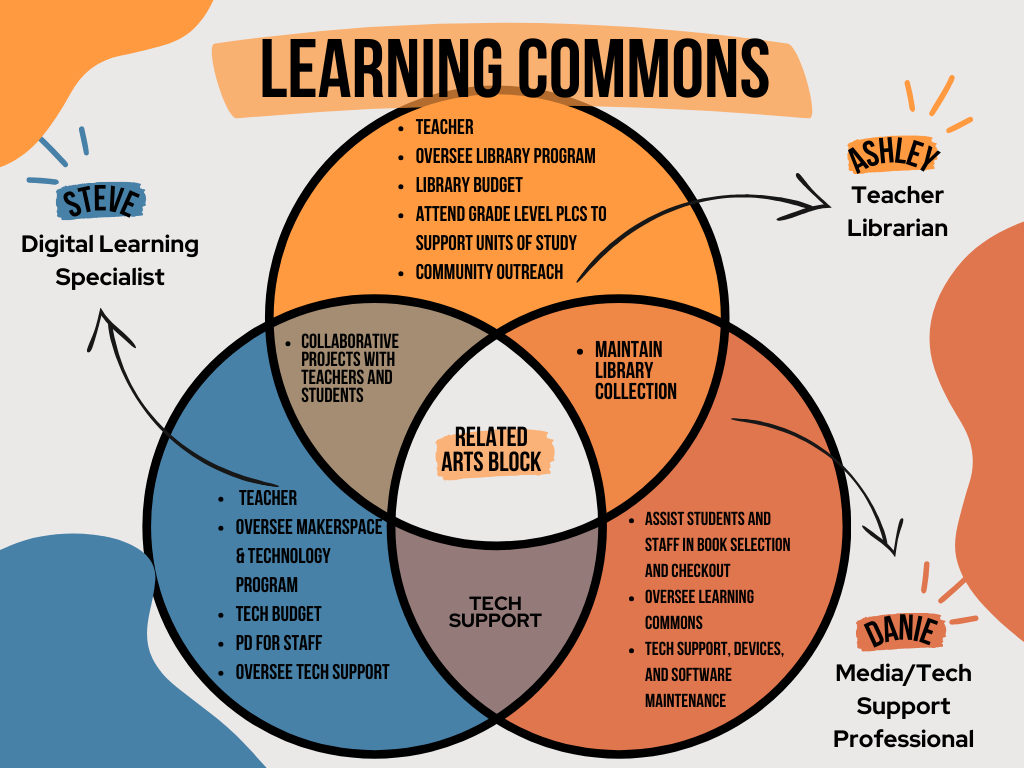
Understanding the change in the physical environment was the easiest part of our presentation for most staff members. Before our initiative, the library was seen as a classroom for whichever group of students was there. With our change, yes, there would be a classroom of students, but others were also welcome. This could include individual students, small groups, and teachers. All staff members welcomed this change. Our goal was to really make the Learning Commons (the former library), the heart and soul of the school.
The part of our presentation that was more complex was the part where we discussed what students would do when they came to their weekly Learning Commons time. (This was the previous year’s scheduled library time.)
We told staff members that when students arrived, they might be greeted by me for a more typical Makerspace activity or by Ashley for a more typical library activity. Whichever one of us was not doing the greeting would be working with students and teachers on collaborative projects, which would be scheduled outside the weekly related arts schedule.
ASHLEY: This was a super exciting opportunity for our school. For the first time, the teacher librarian would be available to launch units with classroom teachers, support research within the classroom during units of study, and conduct read-alouds aligned with classroom content to deepen learning. Additionally, we could ensure technology instruction and Makerspace opportunities were more consistent across grade levels. This idea, however, until fully implemented, was met with some reservation: “Isn’t this just two people doing one job? How is this equitable?” It became clear that we’d need to really deliver in order for staff in particular to see the benefits for their students.
STEVE: One thing that I was doing before the merge of programming was scheduling Makerspace time with each classroom on my own. Classroom teachers didn’t have to stay with their students. They appreciated this because it gave them extra prep time for units of study.
Following some sage advice from fellow teacher librarian, Dr. Rachel Small, once Year 1 began, Ashley and I decided to allow this to continue. Dr. Small continuously reminded us how hard teachers work, something we knew well having both been in the classroom, and anything we could do to help make their jobs easier would be very well received. One nice thing about it in Year 1 was that because we knew we’d see all classes in the related arts schedule, there wasn’t as great a need to schedule additional time regularly with all grade levels. For example, the robots that fifth grade used compared to those used by first grade were much more involved and time-consuming. It was helpful to schedule the extra time with fifth grade but not necessarily first grade for this unit of study.
ASHLEY: When combining forces, we essentially had the opportunity to see all students twice a week, but as Steve mentioned, the flexibility was nice so we could meet students and teachers when it aligned with classroom content. When kindergarten embarked on a science unit, we were able to schedule additional blocks of time (most successful when abutting the fixed related arts block) for students to delve deeply into Makerspace projects. Likewise, when fifth grade students were completing robotics work, we could see them for longer chunks.
STEVE: Our professional goal for Year 1 of our collaboration was to build a trajectory that combined what I had done in the Makerspace with the current SAU’s library curriculum. We both clearly saw the overlap in ISTE and AASL standards and frameworks. Here’s a skills progression we developed that we decided to roll out for Year 1:
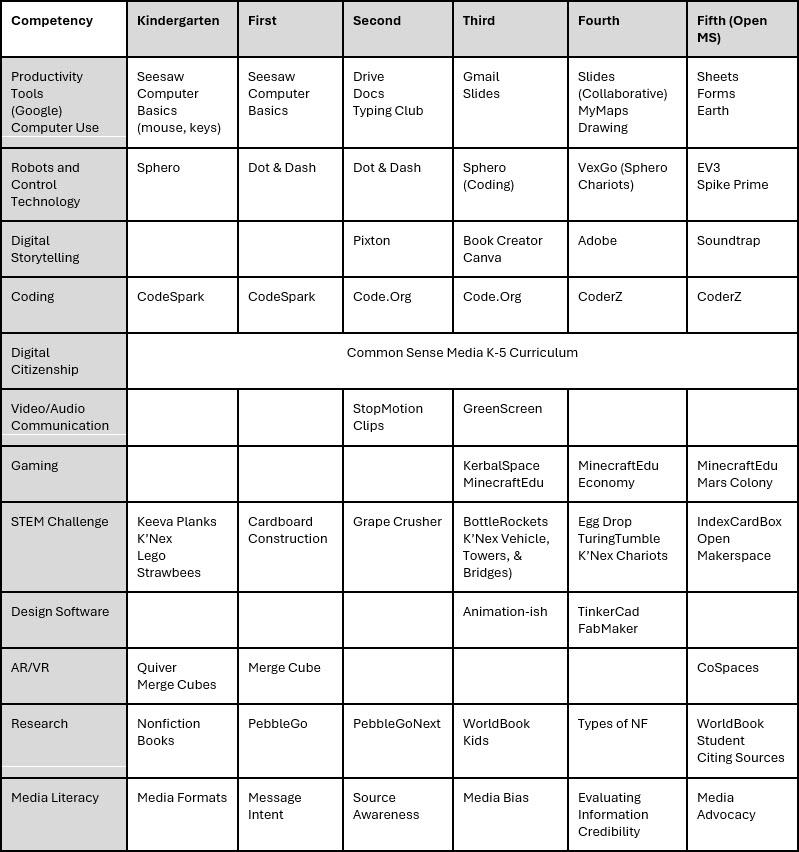
ASHLEY: Some of these skills, apps, or programs were taught during the related arts block, while others were taught in collaboration with the classroom teacher during instructional time or during the additionally scheduled blocks Steve mentioned above.
Finally, while these were the instructional shifts we were making, I think it’s also worth mentioning how we wanted the physical space to allow classrooms to utilize it and its resources independently. By having the Makerspace materials available, and students knowing how to use them independently, we hoped to see an increase in their use across the board. More on that in our next post!
More in this series:
ASHLEY HEALEY
Teacher Librarian, Stratham Memorial School, New Hampshire
Ashley Healey is a National Board Certified Teacher with a passion for reading, writing, technology, and maker culture. She’s dedicated to creating dynamic, inclusive library spaces where students can explore new ideas, develop critical thinking skills, and expand their imaginations.
Ashley serves as the PreK-5 Teacher Librarian at Stratham Memorial School in Stratham, New Hampshire. She also teaches graduate courses at the University of New Hampshire’s Summer Literacy Institute and is the Field Director for the UNH Writers Academy for Youth. Find her at @ashleyhealey.bsky.social.

STEPHEN GAGNON
Digital Learning Specialist, Stratham Memorial School, New Hampshire
Steve Gagnon has worked at Stratham Memorial School since 1993, teaching Grades 3-5. He spent two years as the assistant principal and is currently the Digital Learning Specialist for the school. In 2014, he converted his school’s computer lab into a Makerspace, which continues to grow and thrive today. Steve’s students love the Makerspace program because it enables them to use technology to create meaningful learning experiences. Steve is the New Hampshire Society for Technology in Education (NHSTE) 2012 Pat Keyes Technology-Using Educator Award Winner. Find him at @jstevieg.bsky.social.
Educate, engage, and motivate your students with Makerspaces, innovation labs, and other hands-on learning opportunities. We offer popular products like 3-D printers, design and fabrication tools, robotics kits, and more!
Learn more about our hands-on learning offerings on our Makerspace & Hands-On Learning page or complete the form below and our team will help you identify the resources that best meet your needs and budget.
5 Ways to Refresh Your School Library Collection
August 21, 2026
Before students return for a new school year, many librarians focus on weeding shelves and ordering new books. But a truly effective collection refresh starts with understanding what your data, circulation trends, and community needs are telling you.During a recent...
Read more
An Author Interview with Bao Phi
August 21, 2026
From the Caldecott Honor-winning creators of A Different Pond comes a new picture book that encompasses three generations, two languages, and one universal experience. Receiving a starred review from Publishers Weekly, Ride/Dap Xe is a bilingual story in English and Vietnamese that explores...
Read more
Fall Library Planning Checklist for NYC Schools
August 14, 2026
The era of the “budget dance” is over for New York City’s school libraries thanks to the newly established baseline budget, giving librarians and media specialists greater budgetary confidence when planning collections. This summer, take advantage of this stability to...
Read more
An Author Interview with Ha Dinh
July 28, 2026
Ly-Lan Finds a Way is an illustrated early chapter book series for children ages 6-10 written by Vietnamese American author Hà Dinh. Through warm, relatable stories rooted in school life, family, and friendship, the series explores themes of resilience, empathy,...
Read more
July 17, 2026
Public libraries have spent the past year navigating a book vendor market in motion. If your library has been searching for a public library book vendor with real staying power – one whose ordering technology actually fits how your team...
Read more
Powering Summer Reading Through Partnership and Purpose
July 9, 2026
That’s the impact of this year’s Book Up Summer program, an annual literacy initiative led by Washington-based nonprofit Page Ahead that helps low-income students choose and take home books for summer reading.For the fifth consecutive year, Follett Content supported the...
Read more