
BLOGS > AUGUST 16, 2023
BY JULI K. DIXON

What is the product of 6 x 7? Did you automatically think 42? Teachers in Grades 3-6 spend substantial energy and time helping students to know facts like this automatically. There is little debate regarding the importance of having quick recall of basic facts. What is often up for debate is what to do about the students who continue to struggle to learn their basic facts (Sawchuk, 2023).
The solution to this dilemma is The Fact Tactics™ Fluency Program: Building Reasoning Skills for Multiplication in Grades 3-6 (Dixon, 2023).
According to Ms. Keyes, an assistant principal in a school that used this 20-week, step-by-step program, it is “intentional and easily accessible for teachers and highly engaging for students.”
How much of the anxiety students experience about mathematics can be attributed to time-pressured experiences used to memorize basic facts?
“Evidence strongly suggests that timed tests cause the early onset of math anxiety for students across the achievement range” (Boaler, 2014, p. 469). The resulting mathematics anxiety often serves as a gatekeeper to pursuing mathematics-related careers. Furthermore, if these techniques are successful, why do we need to focus on basic facts with the same students year after year (see Figure 1)?
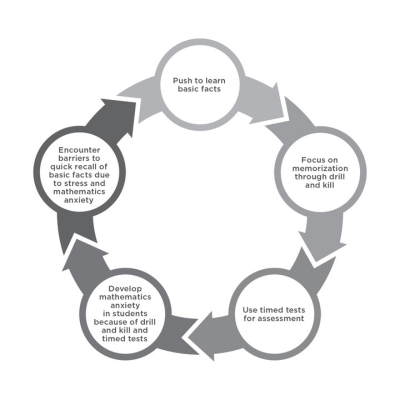
Figure 1: Typical cycle for basic facts instruction (Dixon, 2023, p. 3).
How can we avoid causing anxiety in our students who struggle to develop their knowledge of the facts? Figure 2 provides an overview of the program that answers this question. This 20-week program is described in detail in The Fact Tactics Fluency Program (Dixon, 2023).
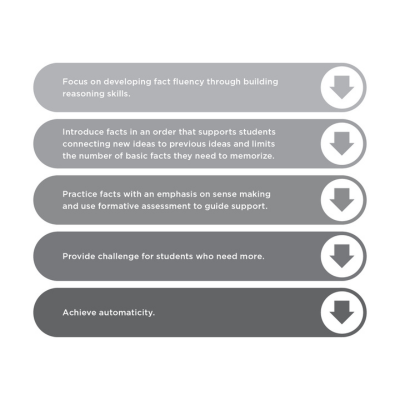
Figure 2: The Fact Tactics Fluency Program pathway (Dixon, 2023, p. 4).
Let’s return to 6 x 7. If you could not recall the product of 6 x 7 automatically, would you be more successful recalling that 3 x 7 is 21 and then doubling 21? The answer is likely yes. This is not automatic recall, but it is quick recall. There are many ways to determine the product of 6 x 7 that go beyond memorization (see Figure 3 for a web of ideas).
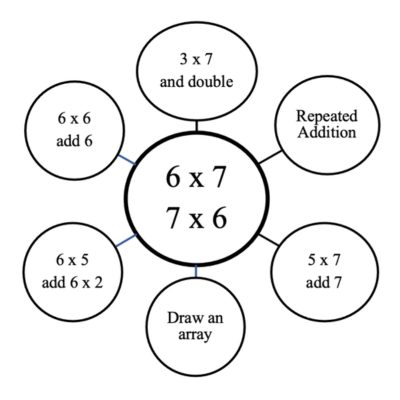
Figure 3: Strategies for determining the product of 6 x 7.
In some cases, thinking about facts using strategies is as important as automatic recall. Using these strategies helps students to develop a deeper understanding of mathematics. This understanding is prerequisite to success with algebra. Readiness for algebra requires “a grasp of the meaning of the basic operations of addition, subtraction, multiplication, and division. It must also include use of the commutative, associative, and distributive properties; computational facility; and the knowledge of how to apply the operations to problem solving” (National Mathematics Advisory Panel, 2008, p. 17). Thinking of 6 x 7 as 3 x 7 doubled is an application of the associative property of multiplication, as follows: 6 x 7 = (2 x 3) x 7 = 2 x (3 x 7).
You also might have derived the product of 6 x 7 by thinking of it as 5 x 7 plus 7 by applying the distributive property of multiplication over addition as follows: 6 x 7 = (5 + 1) x 7 = (5 x 7) + (1 x 7) = (5 x 7) + 7.
Encourage students to use strategies based on the application of properties of operations to determine the products of facts they don’t know. This helps students develop strong links between strategies and different facts. Assess students on their fluency with basic facts using self-assessment where students determine whether they know products of facts or if they are relying on strategies to determine them. These assessments help guide further practice without creating mathematics anxiety caused by timed tests.
When facts are introduced in a strategic order, and students use and practice strategies based on multiplicative reasoning to determine the products, students develop quick recall of basic facts and an understanding of the properties of operations. It is about being Fact Tactical.
“The Fact Tactics Fluency Program is a brilliant program that our teachers and students love! The order of facts and the specific embedded strategies help students make sense of multiplication and it provides prerequisite learning for a variety of standards. Our students have definitely improved in multiplication and are making connections across other math domains.”
–Melissa Logsdon, Numeracy Coach, Robertson County Schools, Tennessee
The FactTactics FluencyProgram
How can students achieve an understanding of multiplication that enables them to go beyond recall to explain their thinking? Author and mathematics education professor Juli Dixon introduces a program that teachers can seamlessly integrate into existing mathematics instruction. Learn six tactics to help you shift from an anxiety-producing, rote-memorization approach to one that helps students actually make sense of multiplication.

Juli K. Dixon, PhD, is a professor of mathematics education at the University of Central Florida. An active researcher, she has also taught mathematics at the elementary, middle, and secondary levels.
References:
Boaler, J. (2014). Research suggests that timed tests cause math anxiety. Teaching Children Mathematics, 20, 469–474.
Dixon, J. K. (2023). The Fact Tactics™ Fluency Program: Building Reasoning Skills for Multiplication in Grades 3-6. Bloomington, IN: Solution Tree Press.
National Mathematics Advisory Panel. (2008). Foundations for success: The final report of the National Mathematics Advisory Panel. Washington, DC: U.S. Department of Education.
Sawchuk, S. (2023, May 1). Kids need to know their math facts: what schools can do to help. Education Week.
New from Follett Content: tonies + Book Bundles Built for Library Circulation
June 23, 2026
New tonies® + Book Bundles from Follett Content are a playful addition to your Library of Things, turning storytime love into everyday reading – all without screens. The unique pairing of audio figurines and print books creates a novel new way...
Read more
We're Book People: The Summer Reads That Made Us Readers
June 5, 2026
Maybe it was a rainy afternoon, a long road trip in the back of the minivan, or a reason to convince mom for a trip out of the house to the library. For most of us who found our way...
Read more
Bilingual STEAM Books Your Youngest Learners Will Love
May 29, 2026
STEAMWORKS from Charlesbridge is an engaging way to introduce young learners to science, technology, engineering, arts, and math (STEAM) through story, character, and entertaining problem-solving. These books feature children of all backgrounds and abilities using scientific, mathematical, and creative thinking to solve everyday problems and...
Read more
Follett Content is now serving public libraries – here's what you need to know.
May 25, 2026
You may know Follett Content as a trusted partner for K-12 school libraries. But we’ve expanded our reach, and public libraries are at the center of that growth.If you’re a public librarian evaluating vendors, exploring options for adult book fulfillment,...
Read more
Graphic Novels Your Students Will Love from Annick Press
May 21, 2026
The intricately crafted worlds and dynamic characters of graphic novels capture the imagination of students of all ages, no matter where they are in their literary journey. These worlds foster deeper cultural understanding while the narratives hone critical thinking skills crucial to...
Read more
Best-Selling SEL Professional Development from Norton Books in Education
May 19, 2026
Cutting-edge research continues to confirm that teaching students social and emotional skills provides enduring behavioral and learning benefits for academic and lifelong success. These hands-on professional development titles from Norton provide school leaders and classroom teachers in Grades K-12 with SEL tools and strategies grounded...
Read more