
BLOGS > AUGUST 4, 2021
BY BETSY POTASH

But are one-pagers really all about art? At its core, a one-pager (originally developed as a classroom tool by AVID) is a no-fluff, just-the-good-stuff version of a set of information. In the business world, a boss might ask an employee to create a one-pager of six months of research so the boss can catch up. In English class, a teacher might ask a student to create a one-pager out of an entire novel, pulling the most important information and ideas from its pages and sharing it through words and images. Either way, it’s about finding the core of what’s worth taking away from something.
One-pagers can seem like the best or the worst pedagogic tool available, depending on what example you happen to be looking at. We tend to see the upper reaches of the example mountain on Instagram. But can one-pagers be useful even if your students aren’t planning their tours of Rhode Island School of Design (RISD)?
It turns out they can.
To find success with one-pagers, just follow three simple steps.
While you’re sure to get some interesting one-pagers if you ask students to simply condense what’s important about a text or unit into one page of information and images, you’re also going to get some terrible ones. It helps students succeed with one-pagers if you lay out exactly what you want included.
For example, for a one-pager on a novel, you might bullet the following elements:
You can tailor these expectations to any type of information, whether you’re asking for a one-pager on a novel, poem, short story, film, or podcast. You can even use one-pagers as a tool to learn more about students, having them create one-pagers about themselves, their reading histories or their families.
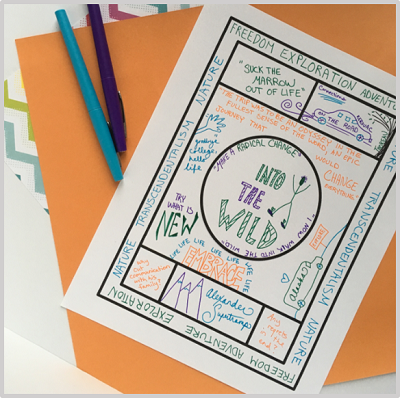
Creating a short rubric that shows how hitting the important elements thoughtfully leads to a strong grade on the assignment. This will help take away the anxiety from students who are uncomfortable with art. It will also make it a lot easier for you to quickly grade your one-pagers and get them up into a display on your classroom wall.
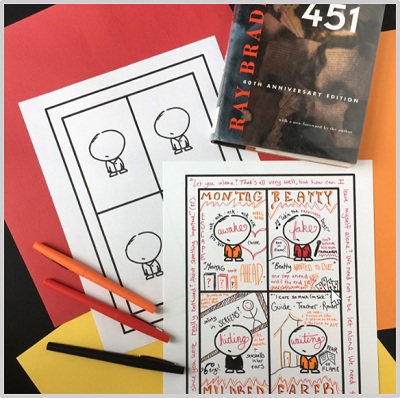
Even with a list of elements to include and a rubric, many students (especially those who hate art), will feel nervous around one-pagers at first. That’s where templates come in. Simply create a page divided into shaped sections and attach each necessary element to a section. It’s amazing how much it helps students relax into the assignment if instead of asking them to include two themes, you ask them to include two themes in the upper left hand rectangle. Simple, but highly effective.
Of course, some students will prefer artistic freedom. Simply differentiate by offering the template as an option, and let students choose. You’ll get creative work through both formats.
Once you get going with one-pagers, you’ll quickly see how versatile they are and how much the combination of imagery and ideas makes information memorable to your students.
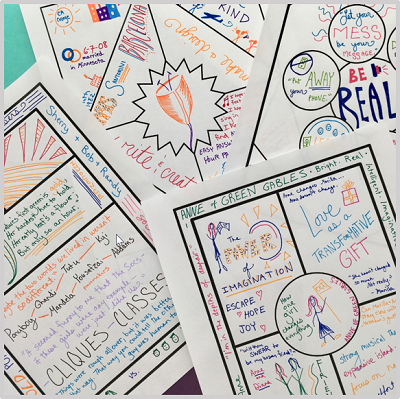
Be sure to save time (once the one-pagers are created) for a gallery walk or mini-presentations to a partner or small group. Let your students see each other’s one-pagers so they continue to expand their ideas of what one-pagers can be like so they’re ready for further depth and innovation the next time you assign one.
|

BETSY POTASH
Betsy’s passion is helping English teachers build innovative and creative lessons. Get inspired and follow along with her at
Search, Curate, and Order Smarter: Titlewave 101 for Public Libraries
September 4, 2026
Grid ordering, EDI, curated lists, and street date delivery – how public libraries put the free Titlewave platform to work every week.
Read more
Six Fall Releases Patrons Are Asking For
September 3, 2026
Up to 25% off if preordered during the sale period.
Read more
Getting Started with Titlewave for NYC School Libraries
September 2, 2026
Building and maintaining your ideal library collection is easier than ever with Follett Content, an approved vendor for New York City (NYC) school libraries. Yes, Titlewave® helps simplify book ordering in FAMIS, but our goal goes beyond placing orders. We...
Read more
Enter the FlutterBee Fall Book Giveaway from Follett Content!
September 1, 2026
Enter the FlutterBee Fall Book Giveaway for a chance to win one of three seasonal book bundles curated for young readers – 15 titles selected to generate excitement and increase engagement this fall.
Read more
The #BritReads26 Bookshelf – September 2026
September 1, 2026
If you follow Britten Follett on social media, you may already be tracking her #BritReads26 journey – a personal commitment to reading and sharing the books that are moving, surprising, and staying with her. Here’s her latest roundup, straight from...
Read more
5 Ways to Refresh Your School Library Collection
August 21, 2026
Before students return for a new school year, many librarians focus on weeding shelves and ordering new books. But a truly effective collection refresh starts with understanding what your data, circulation trends, and community needs are telling you.During a recent...
Read more