
BLOGS > MAY 22, 2025
BY JOSEPH KOSZARY

As someone who’s served as an extended essay coordinator, examiner, and supervisor, I’ve grown deeply familiar with the previous incarnation of the extended essay (EE). Like many of you, years of accumulated experience have made supporting students through the process feel like second nature.
However, change is on the horizon. As the final cohort taking the previous version of the EE moves toward the end of the process, it’s increasingly important for us to engage with the upcoming updates. I’m in the privileged position of having had early access to the new guide and thus more time to focus on the changes. In this post, I’ll share some insights and ideas that will help guide your understanding along, as well as give a taste of what’s available in the recently published textbook from Hachette Learning.
This is an exciting moment for the EE. The last major revision, back in 2018, already feels like a product of a very different educational landscape. Whether we consider technological upheaval such as the rapid evolution and availability of artificial intelligence (AI), the continuing development of pedagogical theories and practices, or global events that have had enormous repercussions in the classroom and beyond, it’s clear that the context in which students learn is continuing to change at a rapid pace. In response, the extended essay is evolving to remain aligned with the IB’s mission: to develop enquiring, knowledgeable, and caring young people who are prepared to navigate – and contribute to – a complex and rapidly changing world.
If I were to characterise the broad changes made, I’d say they’re an evolution rather than a revolution of the EE. They’re in the direction of flexibility rather than rigidity, easing away from prescriptive rubrics and overly defined categories that can sometimes limit students’ enquiries.
A few of the major changes coming are summarised below.
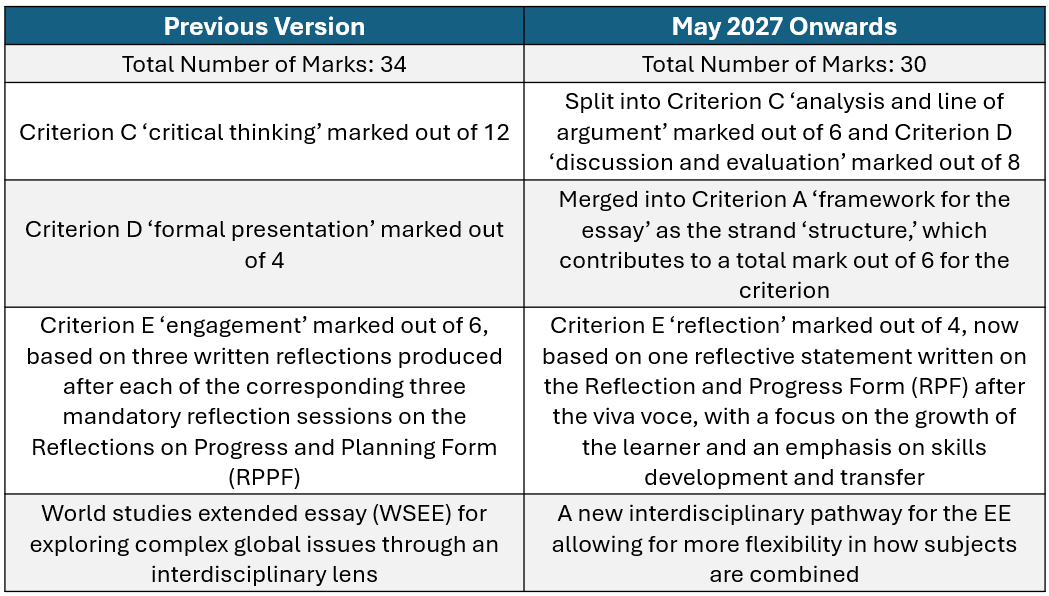
Further changes beyond those listed above have been made and are explored in the textbook, such as the new student-friendly style to the guide, the new document of support materials, and various tweaks to the specific subject areas of the EE. There is also more clarity around academic integrity and integration of AI, something that also will be expanded upon in a future blog post.
The change I’m most excited by is what I consider the ‘big idea’ of the new revision of the component: the interdisciplinary pathway.
In many ways, it’s an expansion of the possibilities afforded by the previous version’s WSEE. While the WSEE was more specifically focused on an issue of ‘contemporary global significance’ and had various requirements such as a local and global context, the new interdisciplinary pathway for the EE affords more range in a student’s enquiry.
The pathway opens up far more opportunities for interesting research questions that combine subjects in new and exciting ways. Students now have more flexibility in combining subject lenses by drawing upon any relevant knowledge, concepts, theories, perspectives, and/or methods from each of their two chosen subjects. Consequently, they can now use two subject lenses on more varied research questions that previously fell outside the scope of a WSEE.
Below are the five main reasons students may take the new interdisciplinary pathway.
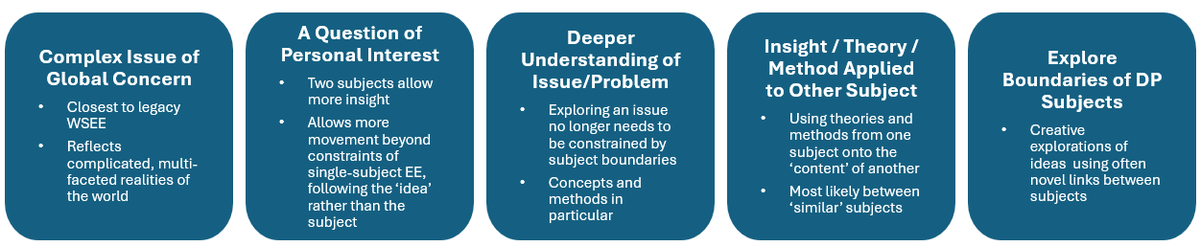
Further details can be found in the newly published Hachette Learning textbook, and I’ll be exploring the interdisciplinary pathway in greater depth in a forthcoming blog post.
ABOUT THE AUTHOR

Joseph Koszary is a highly experienced IB educator. He is the EE coordinator and the English IB coordinator at Sha Tin College, ESF, Hong Kong – an international school and IB World School with more than 1,200 students.
Joseph co-authored the best-selling textbook for English Language and Literature and is an experienced IB examiner with expertise in the extended essay component of the Diploma.
What's a street date program for public libraries, and why does it matter?
May 4, 2026
If you manage adult collections at a public library, you already know the pressure that builds before a highly anticipated book comes out. Holds lists grow long. Patrons ask at the desk. And when release day finally arrives, the copies...
Read more
Follett Content is Back as an Approved Vendor for NYC School Libraries
March 23, 2026
New York City (NYC) school libraries operate at scale and benefit from partners who do the same. Follett Content is once again an approved vendor (#ECO004000), offering support that simplifies ordering while maintaining consistency, including:Local, on-site support with experience assisting school...
Read more
Why Home Libraries Matter: How Books at Home Improve Student Reading Achievement
March 4, 2026
Reading growth doesn’t only happen during the school day. One of the most effective, research-backed ways to support literacy is ensuring students have consistent access to books at home. When students can read outside the classroom – during evenings, weekends, and...
Read more
How to Supercharge Your Summer Reading Program
February 23, 2026
For years, Follett Content has been a leading supplier of books for school libraries and classrooms. With our rich tradition of outstanding service, we’ve fully embraced the opportunity to serve public libraries and are forging ahead by providing essential resources...
Read more
2026 ALA Youth Media Award Winners: Find the Best Children's & YA Books of the Year
January 26, 2026
On their 150th anniversary, the American Library Association (ALA) revealed the ALA YMA 2026 winners and honorees on January 26, 2026, honoring the year’s most exceptional books and media for children and teens. Recognized globally for their impact and excellence, the...
Read more
An Author Interview with Jennie Wood
January 9, 2026
From non-binary author Jennie Wood, creator of the acclaimed graphic novel series Flutter, comes I Didn't Ask For This, which follows a group of kids who share one thing in common: their parents are social media influencers who’ve shared their...
Read more