
BLOGS > FEBRUARY 13, 2024
BY ANDREW DAVIS

‘I hear and I forget. I see and I remember. I do and I understand.’
Attributed to Xunzi (Confucian philosopher, ca. 320–235 BCE)
Inquiry-based learning is central to the experimental sciences and should be at the heart of all school-based curricula. Some parts of the biology syllabus are easier to deliver with this “hand on” approach than others, such as osmosis and enzyme theory. Other topics are more problematic. We have all faced the situation of thinking “How am I going to teach this?” without reverting to “chalk-and-talk” (or its modern version, whiteboard and marker pen) which inevitably fails to deliver a deep-seated understanding of the subject. For example, without practical experiences, cell ultrastructure can be an unexciting and superficial experience for students. Active learning is still possible in these situations, however. As most schools do not have ready access to an electron microscope, creative ways must be found for students to explore and make their own understandings of this topic. Take, for example, the plasma membrane. An activity where students cut out components of a cell membrane drawn onto an A4 sheet, with only brief details provided for each (e.g., phospholipids are amphipathic), and then construct a model based on this information, can provide an effective way for students to understand and remember this key component of cell structure. By using creative and thinking skills, students can develop their own answers to biological questions, even when there is no access to technology which is beyond the scope of school laboratories.
Skills-based learning is at the heart of the new biology syllabus, and by learning through action, students are more likely to develop and retain an understanding of how these skills can be realised. As a result, they are more able to apply their knowledge in novel situations.
The skills that students are expected to experience through the course are encompassed within the tools and inquiry process:
Tools
Inquiry process
An overview of these skills can be found in the Tools and Inquiry section of the 2023 IB Biology Guide (pages 28-33). Guidance on how the tools can be applied in the learning and teaching of the subject can be found as ”Application of skills” in many content statements. These skills provide the foundation for practical work and internal assessment while supporting the application and development of the inquiry process in the delivery of the new course.
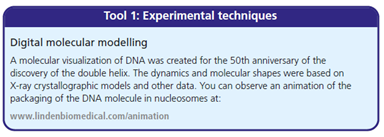
All tools are covered in Biology for the IB Diploma (third edition), and are linked to relevant content statements. This allows these skills to be learnt in context. For example, on page 28, one aspect of Tool 1 is explored in relation to nucleosome structure:
The application and development of the Inquiry process is supported throughout Biology for the IB Diploma (third edition), in close association with the Tools. The new ‘Inquiry’ feature supports the inquiry process, which focuses on aspects of the inquiry cycle. There are three Inquiry boxes: Inquiring and designing, Collecting and processing data, Concluding and evaluating.
For example, on page 7, there is an inquiry activity that allows students to explore the properties of water:
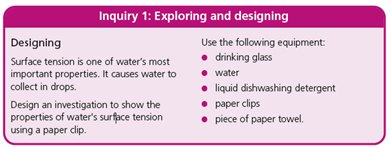
These Inquiry boxes create opportunities for students to design investigations, collect data, develop manipulative skills, analyse results, collaborate with peers and evaluate and communicate their findings. This inquiry allows students to develop skills they will need for their Scientific Investigation (SI) – the Internal Assessment.
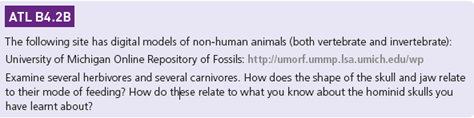
In addition to the Tool and Inquiry features, ATL activity boxes are included throughout the book. Approaches to learning (ATL), including learning through inquiry, are integral to IB pedagogy. The ATL provide the framework for the development of the Tools and Inquiry skills. These activities are designed to get students to think about real-world applications of biology. For example, on page 371 there is an activity that explores the relationship between dentition and diet:
A combination of Tools, Inquiry, and ATL activities, ensures that students encounter and can practise skills throughout Biology for the IB Diploma (third edition).
This blog by Christopher Talbot shows how the topic Water (A1.1) can be taught using an inquiry-based approach.
For more information, visit titlewave.com.
About the Author:

Andrew Davis is co-author of Biology for the IB Diploma (third edition). He has taught biology for over 20 years and is author of a variety of resources for MYP and DP, including Biology for the IB Diploma Study and Revision Guide, IB Diploma: Internal assessment for Biology: Skills for success, and Biology for the MYP 4 & 5: By Concept. He is also author of online teaching and learning resources: Biology for the IB Diploma Teaching and Learning and Biology for the IB MYP 4 & 5 Dynamic Learning.
October 2, 2026
Sometimes, a community exceeds every expectation.When Follett Content began planning its 2026 book sales, the goal was ambitious: Raise $15,000 to support United Way of Greater McHenry County’s Dolly Parton’s Imagination Library Program. By the end of the fundraising effort, that...
Read more
Bilingual STEAM Books Your Youngest Learners Will Love
October 2, 2026
National STEAM Day Book GiveawayIn celebration of National STEAM Day, we're excited to partner with Charlesbridge on a special STEAMWORKS giveaway for educators and public librarians. Ten lucky winners will receive a collection of STEAMWORKS picture and board books to...
Read more
Stock Your Shelves with the Best Fall Books for Classrooms and Libraries
October 1, 2026
Enter the FlutterBee Fall Book Giveaway for a chance to win one of three seasonal book bundles curated for young readers – 15 titles selected to generate excitement and increase engagement this fall.
Read more
PreK-2: A Foundational Skills Checklist for Teachers and Administrators
September 30, 2026
The skills that decide whether a student reads on grade level in third grade get built long before third grade. Here’s what to look for across PreK, Kindergarten, and Grades 1-2 – and what it takes to build the classroom...
Read more
Building a Multilingual School Library Collection in NYC
September 24, 2026
New York City Public Schools bring together a wide range of languages, cultures, and experiences thanks to the diverse communities they serve. A multilingual collection reflects that diversity, gives students opportunities to learn in the languages they know best, and...
Read more
Search, Curate, and Order Smarter: Titlewave 101 for Public Libraries
September 4, 2026
Grid ordering, EDI, curated lists, and street date delivery – how public libraries put the free Titlewave platform to work every week.
Read more