
BLOGS > NOVEMBER 4, 2021
BY LAURA BYARS
Like many of us, I’ve spent the past 18 months working from a home office that was previously a little-used spare bedroom. Since my children are off and living on their own, and my husband works in another home office space, the sounds of the day are consistent – and sometimes monotonous – except for the occasional neighborhood home-improvement project.
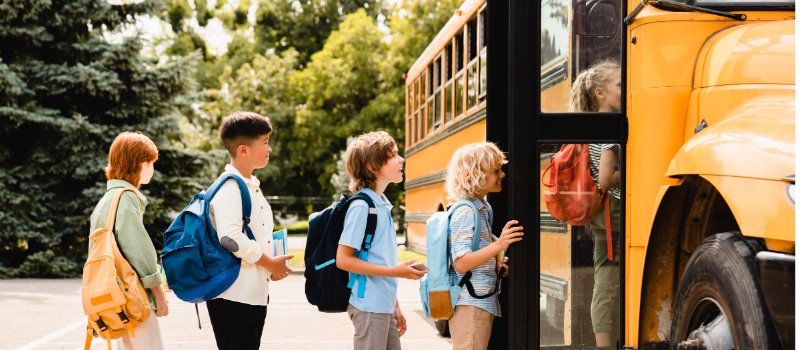
Then, a few weeks ago, I heard something that caught my attention. Looking out the window beyond my laptop screen, a bright yellow school bus stopped in the street and opened its doors as anxious children boarded for their first day of school. Tears welled up in my eyes as a once-routine event, that has marked a shift in my calendar for as long as I can remember, sprang back to life after being canceled a year ago for so many by COVID-19.
I remembered that first-day-of-school thrill. I imagined the bustle of young children clamoring into classrooms, hanging new backpacks on hooks, and arranging pencils and crayons in desks.
While classrooms are approaching some semblance of normalcy this year, there are challenges ahead in the new year – for students and their teachers. In May, the Kaiser Family Foundation published a report stating that during the pandemic, parents reported worsening mental health for their young children. Parents with children ages 5-12 stated that their children showed elevated symptoms of depression, anxiety, and psychological stress.
Not surprisingly, the effects of the pandemic are greater for children with parents working in jobs hardest hit by the economic impact. Family instability and food insecurities compound a lack of emotional well-being.
COVID-19 relief laws bring a welcome ray of sunshine to K-12 education, and school and district leaders have unprecedented support in responding to student needs. Through the CARES Act, the CRRSA Act, and the most recent American Rescue Plan Act (ARPA), the U. S. Department of Education is funneling $190.6 billion to state education agencies through the Elementary and Secondary School Emergency Relief (ESSER) Fund.
States are required to distribute 90% of ESSER funds to local school districts. Funding for non-public schools is also available, either as part of ESSER funding or under separate assistance programs. And new, under ARPA, districts must spend at least 20% of their ESSER III allocation to address learning loss in ways that also respond to students’ social and emotional needs. Funds must target students most impacted by the pandemic – English Language Learners (ELL), minorities, and students from low-income families.
There are so many ideas and options for supporting the social and emotional needs of students, and it can be easy to forget about the value a good book brings in addressing those needs. When informational topics and fictional characters and storylines connect to social and emotional learning (SEL), children have the opportunity to develop important competencies like those identified by the Collaborative for Academic, Social, and Emotional Learning (CASEL): self-awareness, self-management, social awareness, relationship skills, and responsible decision-making. Students can learn how to manage their emotions, make responsible decisions, feel empathy toward others, and build healthy relationships.
Check out this infographic on how to build SEL concepts with literature.
• SEL can be integrated with regular school programming and existing instructional practices.
• Picture books connected to SEL topics can be read aloud to an entire class at the start of the school day or while waiting for the lunch bell.
• Books leveled for reading instruction can be rotated into guided reading collections and book sets for literature circles and book clubs.
• High interest titles can be added to school libraries and teacher classroom libraries to engage students in self-selected reading practice.
As overwhelming as it is to make sure you have everything you need in for your students, it doesn’t necessarily have to be. There are resources to support you.
We’ve gathered all our SEL resources in one place right here for easy access. And if you need additional support, contact your Follett Curation Service team for custom-curated collections of engaging books to supplement core SEL programs or SEL units of study, aligned to specific topics, themes, reading levels, and binding types.
Laura Byars
Laura Byars has been with Follett for seven years and is the manager of the Follett Academic Consultants. She is a former educator with a master’s degree in teaching and a master’s degree in reading and literacy. Before Follett, Laura taught science, middle school language arts, and a summer reading intervention program in a high-performing school district in the western Chicago suburbs. In her free time, Laura enjoys cooking, traveling, running, and biking with her husband and family.
Still picturing us as a K-8 company? Here's what's changed...
October 20, 2026
If you know Follett Content from the elementary or middle school levels, you probably imagine picture books, early chapter books, and the middle grade series students couldn’t put down. That picture isn’t wrong. It’s just incomplete.
Read more
Introducing Follett List Notifications
October 16, 2026
Curated book lists for public library selectors – delivered to Titlewave, free, and reviewed by you before anything is ordered.
Read more
Shelf-Ready Services for Public Libraries: 5 Takeaways from Our Webinar
October 16, 2026
During our Shelf-Ready Services webinar, Trisha Vreeman, Custom Library Services Director, and Corrine Lagacy, Professional Services Manager, showed public library staff how shelf-ready services shorten the trip from delivery truck to shelf. Here's what they covered.
Read more
New Books for Librarians: 30+ Standout Titles from Four Publishers
October 16, 2026
Reader requests pile up, budgets stay tight, and new releases arrive faster than anyone can read them all. So, we brought four publishers together to do the sorting for you.
Read more
A Modern Classic: Building the Public Library Partnership for What Comes Next
October 12, 2026
Last month, Emily Henry announced the title of her next novel: Modern Classic, due out in April 2027. As a reader, I can already imagine the holds lists! But the title caught my attention for another reason: it’s a fitting...
Read more
Why Students Stop Reading for Pleasure and What Schools Can Do About It
October 7, 2026
For schools focused on improving literacy outcomes, reading motivation deserves as much attention as reading instruction.
Read more