
BLOGS > JANUARY 20, 2025
BY HANNAH IRION-FRAKE, K-5 LITERACY COACH

As a former classroom teacher, there are few things as near and dear to my heart as my collection of books. I’d be willing to bet that I’m not alone in that sentiment. But as important as it is to have books in an elementary classroom, it’s equally important to understand where those books fit into instruction in an elementary curriculum. This includes knowing the what, why, and how for authentic texts, hi/lo readers, graphic novels, and decodable text.
Rest assured that all of these types of texts have a place in an elementary classroom. But knowing when to use them falls on the expertise of the teacher.
Decodable texts are an instructional tool that belong in a strong phonics curriculum. Because of this, we often see them in kindergarten, first grade, and second grade classrooms, as well as in reading intervention settings. Decodable texts enable our beginning readers to practice their new decoding skills in an authentic but supportive format, helping them build automaticity with their new phonics skills. But there’s an end to using decodable text. Or, one could argue that all texts become decodable texts once students have become fluent readers!
Once students have the decoding skills to read authentic texts, they should! You can start them off with easier authentic texts, like hi/lo books and graphic novels. Students with the decoding skills to read authentic texts will benefit from ample opportunities to read. This will increase their vocabulary acquisition, build their background knowledge, expose them to more advanced syntax, and support their pattern-learning brain!
But don’t wait until students can read authentic texts to expose them to authentic text. As students are doing the hard work of learning how to read, they should also have opportunities to listen to great authentic texts in the classroom. This will help them practice their listening comprehension and build their oral language capabilities. Read-alouds are a key component in all elementary classrooms, regardless of what kind of texts students are reading on their own.
The way you use a decodable text is different than how you would use authentic text. When using decoding texts, your goal is accurate word reading. You want students to use their sound-symbol knowledge to build strong orthographic knowledge of words. With authentic texts, your goal is comprehension. You want students to develop a deep understanding of the content they’re reading. These different purposes require different approaches for using texts.
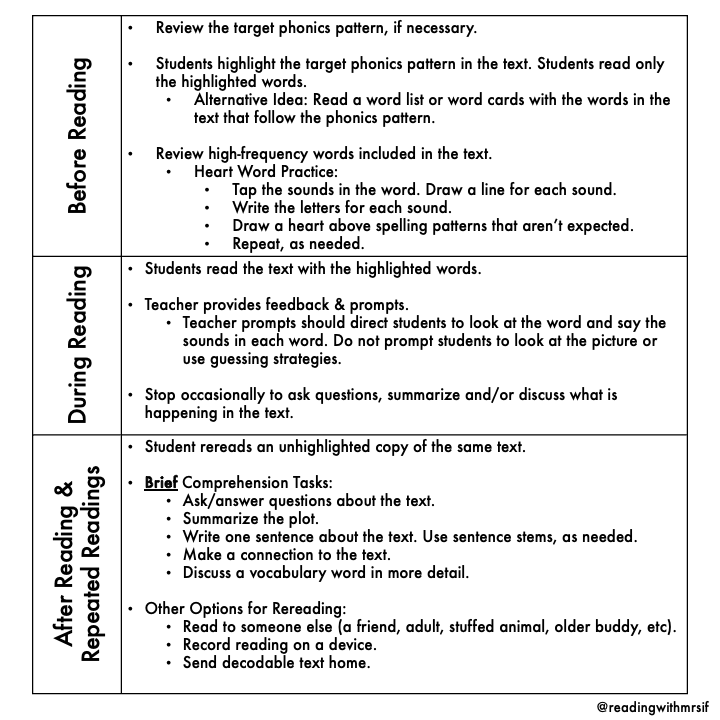
To help support word reading, a decodable text routine can be a useful tool for elementary teachers. There are intentional instructional moves you can use before, during, and after reading decodable text. Teachers should explicitly teach the target phonics patterns and then provide lots of opportunities to read and write with that pattern. The image below outlines a strong decodable text routine.
Instruction for comprehension is a more complex topic. Our goal as educators should be to create the conditions for comprehension to occur. To do this, there are also things we can do before, during, and after reading.
I’ll be sharing more about these different types of texts during my webinar, Different Types of Text: The What, Why, and How for Elementary Classrooms, on January 21 at 4pm CT. I hope to see you there! (Hint: you may also use the same link to watch the recording if you missed the live webinar!)
ABOUT THE AUTHOR:
Hannah Irion-Frake is a literacy coach in Central Pennsylvania with over 16 years of classroom experience. She has degrees in Elementary Education, Reading, and Curriculum & Instruction. Hannah is also a Local LETRS Facilitator. She’s a self-proclaimed literacy nerd. Hannah shares passionately about reading at www.readingwithmrsif.com and on Instagram @readingwithmrsif.
Grow confident and capable readers with Follett Content!
Follett can help you motivate and engage striving readers, including reluctant readers and English learners.
Learn more about resources for striving readers.
Are you looking to support striving readers in your school or library? Get a free consultation on how you can support striving readers in your school!
Search, Curate, and Order Smarter: Titlewave 101 for Public Libraries
September 4, 2026
Grid ordering, EDI, curated lists, and street date delivery – how public libraries put the free Titlewave platform to work every week.
Read more
Six Fall Releases Patrons Are Asking For
September 3, 2026
Up to 25% off if preordered during the sale period.
Read more
Getting Started with Titlewave for NYC School Libraries
September 2, 2026
Building and maintaining your ideal library collection is easier than ever with Follett Content, an approved vendor for New York City (NYC) school libraries. Yes, Titlewave® helps simplify book ordering in FAMIS, but our goal goes beyond placing orders. We...
Read more
Enter the FlutterBee Fall Book Giveaway from Follett Content!
September 1, 2026
Enter the FlutterBee Fall Book Giveaway for a chance to win one of three seasonal book bundles curated for young readers – 15 titles selected to generate excitement and increase engagement this fall.
Read more
The #BritReads26 Bookshelf – September 2026
September 1, 2026
If you follow Britten Follett on social media, you may already be tracking her #BritReads26 journey – a personal commitment to reading and sharing the books that are moving, surprising, and staying with her. Here’s her latest roundup, straight from...
Read more
5 Ways to Refresh Your School Library Collection
August 21, 2026
Before students return for a new school year, many librarians focus on weeding shelves and ordering new books. But a truly effective collection refresh starts with understanding what your data, circulation trends, and community needs are telling you.During a recent...
Read more